AI projects rarely fail because of technology

Muamer Nukic, AI Specialist at RWZ, shares insights into how RWZ is integrating AI into everyday business operations—step by step. We spoke with him about AI adoption, change management, and what makes an AI project successful.
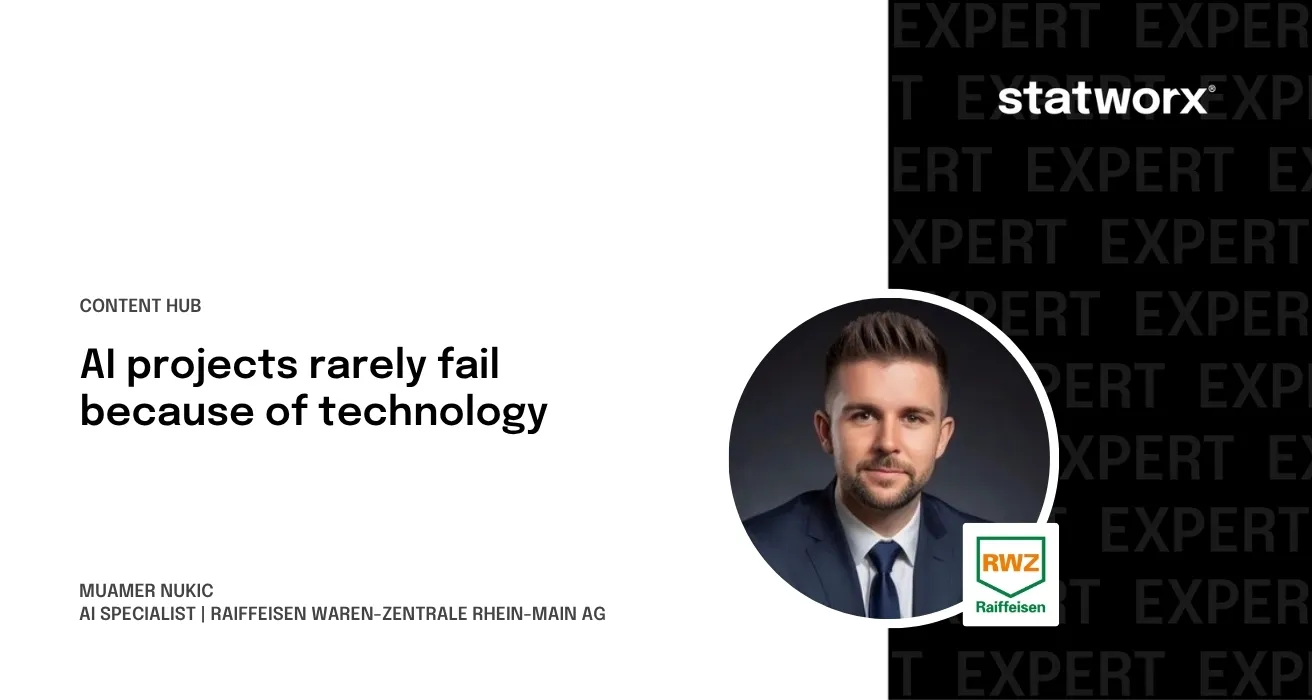

To provide our readers with more high-quality expertise, we conduct regular interviews with leading experts in AI, data science, and machine learning. Interested experts are warmly invited to contact us for exciting collaboration opportunities: blog@statworx.com.
About RWZ
Raiffeisen Waren-Zentrale Rhein-Main AG (RWZ) is one of Germany’s leading agricultural trading and service companies. Headquartered in Cologne, the cooperative supports agricultural businesses across the entire value chain—from agricultural trading and machinery to building materials, energy, and a wide range of services.
In conversation with Muamer Nukic
How can a traditional company successfully navigate AI transformation? This is the question Muamer Nukic, AI Specialist at Raiffeisen Waren-Zentrale Rhein-Main AG, deals with every day.
As RWZ’s central point of contact for AI, Muamer supports projects from the initial idea through to implementation and helps employees use AI effectively and responsibly in their day-to-day work. In our conversation, he shares insights into his daily work with AI, reflects on the collaboration with statworx, and explains why successful AI adoption is, above all, a people issue.
When the ChatGPT boom began around three years ago, RWZ initially experienced what many organisations did: people started experimenting. AI was used to write texts more quickly, draft emails, and simplify smaller day-to-day tasks. However, it soon became clear to Muamer that these early experiments pointed to something much bigger.
“Only later did it become clear how much potential AI truly has in a business context—from automation to entirely new ways of working.” M. N.
Today, he is responsible for driving the strategic development of AI across the RWZ Group. His role goes far beyond traditional technology topics. In addition to identifying new use cases, he is involved in business case evaluations, process analysis, change management, and employee training related to AI. This is precisely what makes his day-to-day work so diverse: sometimes strategic, operational or technical—and always closely connected to the real challenges faced by the business. One aspect he finds particularly exciting is analysing AI use cases from other organisations and assessing which approaches can be meaningfully applied at RWZ.
“Often, you only realize which processes aren’t yet optimized or where the underlying data needs improvement when you directly compare yourself with other companies.” M. N.
AI with real business value, not just hype
Growing market pressure and the rapid pace at which AI technologies are evolving were key reasons why RWZ decided to engage with AI strategically at an early stage. From the outset, the focus was not only on the technology itself, but above all on one question: Where can AI create real value in day-to-day business?
RWZ sees significant potential in areas such as customer service, sales support, and product advisory services. However, before ideas can become productive applications, a clear structure is required. For this reason, RWZ works with a structured use case funnel. New ideas are collected and then evaluated step by step. What data is required? Which technologies are suitable? Can the solution be implemented internally, or is external support needed? And most importantly: does the business case justify the effort involved? Not every good idea automatically makes for a viable AI use case. At the same time, the company aims to strike the right balance between quick wins and long-term transformation.
“Quick wins are important because they create visible success early on, build acceptance across the organisation, and enable organisations to realise value from AI quickly.” M. N.
Why AI projects really fail
The more deeply RWZ engaged with AI, the clearer one thing became: the real challenge rarely lies in the technology itself. Many companies initially focus on models, tools, or technical capabilities. In practice, however, the real stumbling blocks are often long-established processes, missing documentation, or a lack of acceptance among employees.
“In my view, many AI projects fail not because of the technology, but because of a lack of acceptance and insufficient involvement of the business departments.” M. N.
Particularly in large organisations, processes often contain numerous exceptions, individual workarounds, and implicit knowledge that has never been properly documented. This is where the real work begins. Before processes can be automated or supported by AI, organisations first need to understand how those processes actually work. For this reason, RWZ deliberately involves business departments at an early stage and analyses processes in a transparent manner. Methods such as process mining also play an important supporting role.
“Projects are generally most successful when the initiative and the specific need arise directly from the business, because that is where the real potential for improvement lies.” M. N.
Alongside process understanding, change management and communication play a crucial role. Many employees initially approach new technologies with a degree of uncertainty, particularly when it is unclear how AI can create tangible value in their own day-to-day work. RWZ therefore deliberately takes a practical approach. Rather than focusing on abstract theory, the emphasis is placed on real-world applications, personal conversations, and hands-on experimentation.
“AI adoption works particularly well when the exchange is personal and practical.” M. N.
Implementing the CustomGPT solution
This focus on collaboration and acceptance also played a central role in the implementation of a company-wide chatbot solution together with statworx. For Muamer Nukic, it was particularly important that the initiative was not viewed as a purely technology-driven project, but as a joint transformation effort characterised by a clear structure and close collaboration. One aspect he highlights especially positively is the transparency of the partnership: clear roadmaps, well-defined responsibilities, and a shared understanding of how specific decisions would impact the project.
“Throughout the entire project, we were continuously kept informed and given a clear understanding of how certain decisions—or missing steps—could affect the outcome.” M. N.
This quickly created the feeling that RWZ was not simply introducing another chatbot, but implementing a solution capable of delivering real value in everyday business operations. Today, the solution is used across a wide range of business areas. Some teams use AI to automatically extract information from supplier delivery notes and process structured data further downstream. Others rely on customised assistants for documentation, research tasks, or email drafting.
Speech-to-text applications and individually configured AI assistants for recurring daily tasks have also proven particularly popular. Teams have already developed their own prompts that automatically gather and consolidate information such as wheat prices, exchange rates, or gas prices from various sources.
“Essentially, employees have been given a modern tool that enables them to make their daily processes simpler and more productive.” M. N.
According to Muamer, employees particularly appreciated the fact that they can now use AI officially within a secure corporate environment, without having to rely on shadow AI solutions. This has led to significantly greater trust in the technology and, at the same time, a greater willingness to actively experiment with new use cases.
Learnings: Successful AI projects require more than good technology
Looking back, the project at RWZ not only resulted in new AI applications, but also fundamentally shaped the organisation’s perspective on professional AI transformation. For Muamer Nukic, one of the most valuable experiences was seeing just how important structure, communication, and clearly defined responsibilities are to the success of AI projects—far beyond the technology itself.
“The project with statworx significantly broadened my perspective on the professional implementation of AI initiatives.” M. N.
What impressed him most was the structured project management approach, characterised by clear roadmaps, transparent ownership of tasks, and a shared understanding of priorities and next steps. The project also provided valuable technical insights, particularly when it came to understanding which technologies and large language models are best suited to different use cases, as well as their respective strengths and limitations.
“The statworx team always explained complex topics in a very accessible way while providing a level of technical depth that delivered real value.” M. N.
What AI-advice would Muamer give to other companies?
For organisations currently facing similar challenges, Muamer Nukic has one clear recommendation: do not think about AI in isolation or purely as a technology topic.
The AI market is evolving at an extraordinary pace, and smaller internal teams in particular can find it difficult to keep track of every new development on their own. External partners can contribute not only technological expertise, but also help organisations avoid common mistakes and gain fresh perspectives on existing processes. Equally important, however, is the human aspect. Successful AI adoption is not driven by information portals or theoretical guidelines alone. It is built through personal interaction, practical experience, and opportunities to apply the technology in meaningful ways. This is why RWZ deliberately focuses on hands-on formats, interactive training sessions, and collaborative experimentation. Employees should not only understand AI—they should experience first-hand the value it can create in their daily work.
“In my experience, AI adoption works best when the exchange is personal and practical.” M. N.
Interactive formats such as prompt engineering workshops, AI challenges, or hands-on training sessions can be particularly effective in lowering barriers to adoption while fostering curiosity and enthusiasm for new technologies.
Looking ahead
Looking ahead, Muamer Nukic expects AI to have a particularly significant impact on repetitive tasks and documentation-heavy processes over the coming years. AI will increasingly become an everyday workplace assistant—making knowledge more accessible and helping employees handle routine tasks more efficiently. Despite all the technological advances, one insight remains central for him:
“Successful AI transformation does not start with technology—it starts with the people who work with it.” M. N.
statworx comment
Successful AI transformation goes far beyond technology. What matters is embedding AI strategically within the organisation, creating tangible business value, and actively bringing employees along on the journey. This is exactly where statworx supports organisations. Our services range from AI Strategy & Consulting and the development of custom AI solutions and CustomGPT applications to AI enablement, training, and change management. Together with our clients, we develop practical solutions that create measurable value and help employees work more efficiently in their day-to-day roles.
Our goal is to help organisations not only implement AI from a technological perspective, but to establish it successfully and responsibly across the business over the long term.